

What is Business Analysis?
The Business Analyst is an indicator of change. Business Analysis, whether for-profit companies or not-for-profit businesses, It is a disciplined approach to promoting and managing change in organizations, whether public or government agencies.
Business analysis is used to identify and articulate the need for change in the way organizations operate and to facilitate that change. Business analysts identify solutions that will maximize the value an organization delivers to its stakeholders. Business analysts work at all levels of an organization and can be involved in everything from defining strategy, creating enterprise architecture, defining goals and requirements for programs and projects, or taking a leadership role by supporting continuous improvement in technology and processes.
The value of business analysis is in realizing benefits, avoiding costs, identifying new opportunities, understanding required capabilities, and modeling the organization. Through the effective use of business analysis, we can enable an organization to realize these benefits and ultimately improve the way it does business.

Most Used Business Analysis Techniques
MOST: Most are a short form of the Mission, Objectives and Strategies set. It allows business analysts to perform a thorough internal analysis of what an organization’s purpose is and how to solve such problems.
SWOT: Swot is a complete form of Strengths, Weaknesses, Opportunities and Threats. This technique helps you find areas that are both strong and weak.
MOSCOW: The must or should, can or can process is MOSCOW’s form. This technique allows each requirement to be prioritized over the others.
CATWOE: It stands for Customers, Actors, Transformation Process, World View, Owner and Environment. The CATWOE technique helps you recognize processes that can be affected by any action the business undertakes.
THE 5 WHYS: This technique is one of the most important of the job analysis techniques. It consists of leading questions that allow business analysts to identify the root cause of a problem by asking why the situation occurred.
SIX THINKING HATS: With this technique, you can evaluate alternative perspectives and ideas.*creative thinking*talk about bigpicture.*logical, data-driven thinking*positive thinking mostly focused on professionals*emotion-based reactions*opposite thinking ?
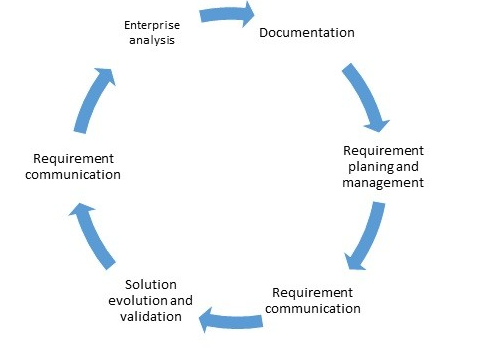
Steps involved in Business Analysis Process